
Why I am not a TERF
It's not the "TE" I have a problem with, it's the "RF"

In recent days, JK Rowling, creator of Harry Potter, Queen of the TERFs, and - all jokes aside - heroic woman who spoke out against the evils of gender ideology long before it was ok to do so - has upped her ante on GC (Gender Critical) Twitter. This has not gone unnoticed. Elon Musk dared to suggest that she broaden her content a bit…
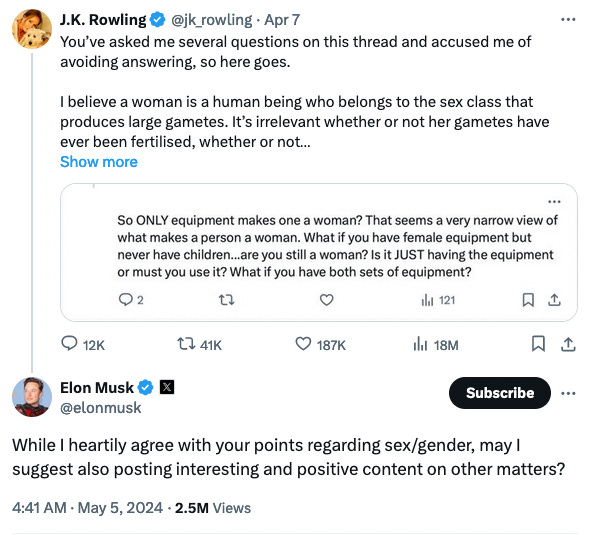
…and in a move surprising no-one, out came the feminists with their accusations that Musk was “mansplaining” and only telling Rowling what to post because she was a woman. The interaction between the two, which Rowling appeared to have no issue with...
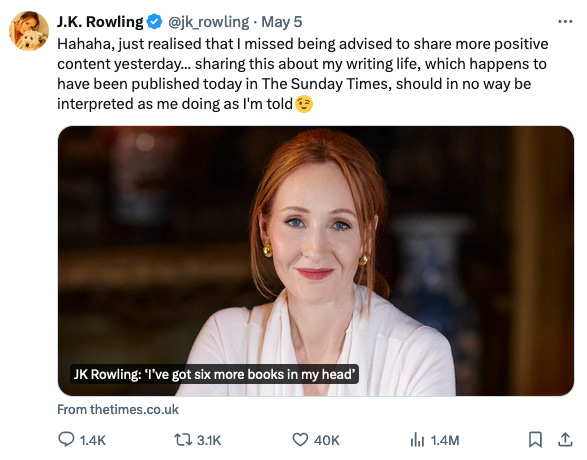
even made the legacy media news.
Cue the pile on…
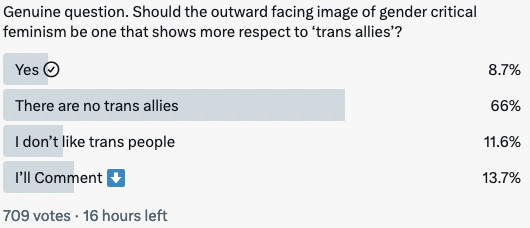
So, I’m sure when Debbie Hayton weighed in on JK Rowling’s X comments mere days later, he knew full well that he was going to trigger his own pile on of GC feminists. This is a scenario with which Hayton has quite some familiarity. Being one of those blokes who dons a dress and adopts a female name, he is the natural enemy of the TERF. As shown by an in-progress X-poll:
And they didn’t let him down. Among the predictable responses were the accusations that he is an abusive partner, and claims that his Spectator article fit some male pattern of abuse, as well as numerous versions of “I told you so”. As though by criticising JK Rowling, Hayton had revealed some long-hidden secret that many had suspected but could never prove... until now. One might expect that upon reading his piece in The Spectator, the clandestine drama of it all would be laid bare. One did read the Spectator piece. And One was very disappointed on the clandestine front.
The full piece is linked above, out from behind the paywall, so you can read it for yourself. And here’s Hayton discussing his message. But the main message appears to be fairly straightforward. Rowling holds very strong views, for which she is rightly celebrated, that trans “rights” should not extend to permitting men (specifically men insisting that they are women) to enter single-sex spaces designated for women, women’s sports, or indeed to enter the category of “woman” for any consequential purpose. [Just as an aside, these are all views for which Hayton himself also advocates.]
Hayton observes that Rowling has, historically and more recently, posted thoughtful, messages about trans rights and trans people. Messages that demonstrate Rowling’s compassion and respect for trans people to dress and present as they please:

He goes on to observe that the compassionate tone of messages such as this one, seem to be at odds with some of Rowling’s recent posts, in particular an exchange she had concerning a specific trans-identifying man (who goes by the name of Lucy Clark, more on him below). Hayton then goes on to speculate whether Rowling has actually lost some of the compassion for trans people that she expressed a month ago, or whether she is allowing the social medium of X to get the better of her.
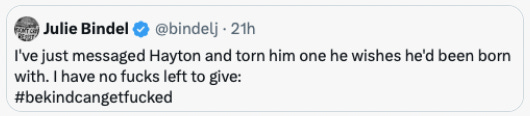
On all of these points, I have no quibble with Hayton. It is a reasonable question to ask. The days since have seen the TERFiverse mock Hayton relentlessly for “tone policing” and the more vicious actors have been proud to do even worse:
Hayton goes on to argue that quote-posts (where you post another user’s comment, with your own comment preceding it) are a brutal weapon in the social media wars, especially when wielded by an account with millions of followers. A quote-post accompanied by a derogatory comment, can trigger the quoter’s millions of followers to pile on the quotee. This too appears to be an entirely sound observation. Certainly Lucy Clark copped a barrage of attention over the weekend as a result of being mentioned by JK Rowling. I wil point out though, my Treasured Reader, that some modest digging has substantially diminished any pity one may have felt for Lucy. He has been goading Rowling for years, and certainly seems like someone you might bump into next Tuesday. The barrage of attention he copped appears to have been just what he’s always wanted.
It seems reasonable to suggest that many in the TERF community take their lead from JK Rowling. Rowling’s recent quotes, and the low pressure system building around them, do indeed seem to have heralded an increase in the general nastiness of TERF chatter, at least from what I can see. There is also no doubt that accounts with millions of followers can cause much smaller accounts to be overwhelmed with attention - both positive and negative - via a quoted post. That’s not even a remotely controversial observation. Therefore, Hayton raises a worthy point of discussion. Was JK Rowling’s recent deviation from emphasising compassion towards a community who typically repay her generosity with spiteful accusations of “transphobia“ on the good days (and with rape and death threats the rest of the time) borne out of a deliberate change in strategy? Or did frustration get the better of her? And, if the former, is the change in strategy, and the effects that will ripple from it, likely to be effective?
Is it helpful, is it necessary, and is it true?
Perhaps Hayton’s only mis-step in this article comes in the final line. After suggesting that Rowling’s recent posts are likely to be amplified out of context, and less politically effective at winning over undecided punters than her more compassionate messaging, Hayton draws on his experience as a teacher and pulls out the “is it helpful, is it necessary, and is it true” trifecta. This is the line used to discourage teenagers from posting messages others may find hurtful on social media.
I don’t think that Hayton invoking the image of himself providing social media tutelage to students helped his case. It made his criticisms appear more condescending than they were. The Rowling tweet from the exchange in question, which Hayton chose to highlight was the devastatingly direct “I didn’t compare him to one. He IS one.”
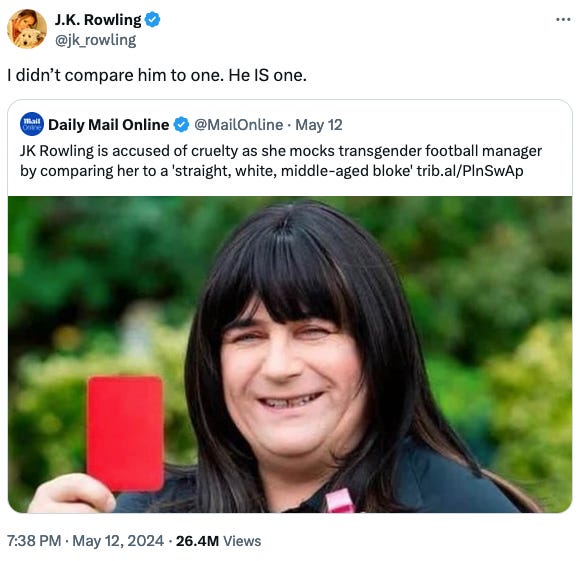
If we were to apply Hayton’s rule of three to this tweet: Firstly, it is absolutely 100% true. That’s a gimme. That is absolutely a man. I am also very sympathetic towards the necessity argument. The MailOnline referred to him as “she” and in the post-truth world we live in, every gaslighting lie does need to be called out. Which leaves only helpful. While Hayton likely has a point that some of Rowling’s less sympathetic tweets in this exchange are unlikely to appeal to compassionate fence-sitters, the example he provided doesn’t really fit that bill. Being able to call transwomen “men” and transmen “women” (because that is what they are, regardless of how they present, or what they claim to be) is now a focal point of the battle to preserve sex-based rights (if you aren’t familiar with the Tickle v Giggle court case - nope, not making that up - now would be a great time get familiar with it here). On that front, every time this truth is stated it IS helpful.
Hayton’s apparent conclusions are that Rowling’s recent comments, especially those referencing specific individuals, don’t reflect the respect and compassion she espouses in longer form posts, and make her a less effective Gender Critical voice in this culture war. Whether you agree or not, the point is validly argued.
So what exactly is the big deal?
If you’re wondering, Treasured Reader, what all of this has to do with accusations that Hayton is an abusive man, who has revealed his true colours with this article, then you probably aren’t up to speed on the TERF scene. Allow me to do my (no doubt, inadequate) best to get you up to speed.
TERFs are Trans-Exclusionary Radical Feminists. Trans-Exclusionary simply means that trans-identifying males (“transwomen”) are excluded from TERF’s definition of women. The RF seems to be less important in than the TE. There are certainly trans-exclusionary TErfs who do not appear to hold radical feminist views, being infinitely more sensible than that. There are also UltraTERFs. The distinction between UltraTERFs and regualar TERFs seems (to me, anyway) to be largely in their willingness to use wrong-sex pronouns. UltraTERFs will banish and condemn anyone willing to ever refer to transwomen as “she”. The regular TERFs will on occasion use wrong-sex pronouns for trans people, especially fellow gender-critical ones, like Hayton.
The distinction between gender critical trans people and other trans people, is not recognised by the UltraTERFs. They just see them all as men (well the male ones, anyway). This wouldn’t be a problem in and of itself (all men identifying as transwomen are indeed men) except, we know what radical feminists think of men. And this particular brand of UltraTERF while appearing to recognise JK Rowling as their rightful Queen, do not share the author’s compassion for people who desire to present as the opposite sex, and do not wish for them to be able to be free to do so:
“There are no "good ones". There may be nice troons, but they are never on our side totally. Because if they were, they wouldn't be troons.“
And so Debbie Hayton being a man, albeit a gender critical one, is treated with the same flavour of contempt by some TERFs as radical feminists hold for men more generally. And this is of course intensified by the fact that Hayton is also a trans-identifying man.
A naive onlooker might think that a gender critical transwoman would be an important voice in the fight against gender ideology. Hayton is straightforward about the fact that he - and all other transwomen - are indeed men. Hayton is open about being an autogynephile. He argues for evidenced-based approaches to understanding autogynephilia. He argues against children being exposed to gender ideology. He is highly critical of the gender ideology that once held him captive. And in being a gender critical transwoman, Hayton falls foul of the tribalism on both sides of the gender debate. To the TRAs he is a traitor, and to the TERFs a troon.
And so Hayton’s criticism of Rowling was met with the same toxicity that any man can expect to receive for voicing an opinion in the vicinity of a rad-fem woman. He was accused of being an “abuser”, of telling a woman to “be less angry and emotional” and to “be kind”, “check your tone” and “listen little girl”. None of these things are quotes from his article (in spite of the quotation marks used by the rad-fems who posted these comments), and none accurately reflect the argument he mounted. I have doubts about how many of those joining in the Roast of Hayton even bothered to read his peice.
One rad-fem wrote that abusers like Hayton are “incapable of seeing anything from a perspective other than their own“, which is certainly ironic. Not just because they’re the words of a badly charred pot. But because it seems to have escaped most of these UltraTERFs that, assuming JK Rowling is sincere in her longer posts on the topic, their position that every trans identified man is The Enemy, is not a position that JK Rowling herself seems to share. In their fervour to defend Rowling’s honour by tearing Hayton “the hole he wishes he was born with”, they are not emulating the strength and compassion that have been the hallmarks of Rowling’s anti gender-ideology stance. Rather, they are emulating the smug, petulant thuggery of the TRAs (trans rights activists) they have spent years mocking as the #bekind crew, who practise “kindness” only in the most Orwellian sense of the word.
It’s the RF, rather than the TE that’s the problem for me
Transwomen are men, and transmen are women. Women identifying as non-binary are women, and men identifying as non-binary are men. There are only men and women. The two categories are mutually exclusive, all-encompassing, and immutable. I would clearly have no problem with the TE part of the TERF acronym. It is the RF part that I am just unable to reconcile.
My problem with the RF in TERF is not limited to their blunt condemnation of all trans identifying men, or their refusal to engage with any other TErf who dares to use a wrong-sex pronoun on occasion. These are symptoms of the broader problem with rad-fems in any sphere. They are ideologues, as disinterested in evidence and truth as the TRAs they despise.
This is why so few (if any) of them are engaging with anything Hayton actually argued in his piece. I’ve seen dozens of posts seething at Hayton for his article, and many more declaring with bewildering triumph that criticisms of Rowling somehow prove that Hayton never supported women’s rights. TERFs falling over themselves to point out that they never trusted him, that they were never fooled by him. But I’ve yet to stumble across one offering a sensible critique. I’m not saying there are none - across all of X, surely there are some - but the overwhelming majority of condemnation is entirely undefended.
Radical feminists seem to think that the righteousness of their condemnation is self-evident. Hayton is a man offering a critique of a woman, and not just any woman, but the Queen of the TERFs. For the rad-fem that is a sufficient felony to forego judge and jury, and move straight to executioner. It is that intolerance and disregard for men, and the ad hominem gate-keeping of truth, evidence, and argument that firmly excludes me from their group.
I’ll never be a TERF. I cannot align with any currently recognisable stripe of feminism. Feminists will only ever consider me an MRA (Men’s Right Activist). Much like being accused of being a transphobe, MRA is not an accusation that should trouble Serious People. Nor does it trouble me. I do care about men’s rights but the irreconcilable differences I have with feminism are as much over the harms it inflicts upon women as those which it inflicts upon men. Many who join me in my condemnation of feminism may not agree with me on this, but men are not the natural enemy of feminism. Women are. Men are merely the collatoral damage, the civilian death toll in women’s civil war.
And with views like that, I have something in common with Debbie Hayton. The Venn diagram of Tribes I Might Belong To has a sliver of overlapping space that is very sparsely inhabited. I also find that I often agree with Hayton’s take on things. Less so the piece in question, about which I am ambivalent - I think that both Debbie Hayton and Helen Joyce make sensible points in the video linked above. But more generally speaking there is plenty of common ground between Hayton’s gender critical views and my own. I also respect Hayton for continuing to contribute to this debate when he full well knows that the majority of people in both tribes are baying for his blood.
Hi Dr. Dani, I found your Substack after listening to your very excellent interview with Tim Kelly. It seems like terf fits your category of preferring ideology over ideas.
Great article Dani. I am in a similar camp. If the end game is removing the idea that sex is interchangeable, that we need safeguarding for minors and women, the sanctity of single sex spaces need to be preserved, that there is not such thing as a trans child then I think we should be open to whoever is in that camp to achieve those end goals and I consider Hayton, like Skye Vittriti, Blaire White and Buck Angel some of those key voices in achieving that end goal. I agree with you that the RFs become a mirror for the TRAs. It is easy to forget the end game and I think that many of the old skool transexuals have an important contribution to make in understanding gender dysphoria and pushing back against the radicalisation wrought by TRAs. I also don't understand when Hayton is referred too as a abuser - his wife is still in relationship with him and deserves the dignity to live without being cast as some weak and pathetic woman.